Saturday, October 29, 2005

Does anyone care?


I've been getting an uneasy feeling lately.

As American Christians, we claim to love the people of the world, yet we don't even seem to notice when they are dying.

There have been a lot of headlines lately when the US casualty count in Iraq hit 2000, but has anyone noticed that the civilian body count has hit an estimated 25,000?

Everywhere you turn, there are fundraisers for those impacted by Katrina. That is appropriate -- I've gladly contributed myself, and it makes sense that we should take care of our own people.

But here's my question: what about the people who are suffering from the earthquake in Pakistan? It's not even mentioned on most news programs any more. No one really knows how many have died. Some say 55,000. Some say 80,000, but no one really knows, partly because half a million people have not received ANY aid because no one has even reached them yet and the dead have not been counted.

People are dying daily from preventable diseases, such as tetanus. 3 million are without food and shelter, and winter is setting in. Due to the combined effect of the mountainous area and the roads destroyed by the earthquake, the only hope for many of these people is via helicopter, which frankly is going to require international donations both of cash and of equipment. This isn't yet a reconstruction effort, it is still a critical rescue phase. It's too late for the people who are buried, but it's not to late for many of the injured and homeless, if they are rescued before they have gangrene, and before they freeze to death, and before they starve.

Save a life today. Donate to World Vision, or to another agency that is on the scene.

But now that I've said the serious stuff, I'll mention a funny aside. In a peculiar twist of fate, I actually know the prime minister of Pakistan (not that he would remember me). Several years ago we worked together on the same computer project. I can't quite recall whether I taught him how to make his own coffee. That was before he was prime minister, of course.

Sunday, October 23, 2005

Flaky Intercession

I've been reading a lot about prayer lately. I find that God knows how to work with my personality (He should, He created me!), and since I am an 'information person', he often communicates with me by causing me to want to read about something. And then somewhere down the line I start wanting to bring it into real life. So as I said, I've been reading a lot about prayer lately (and have gradually been starting to actually pray more too).

The title of this blog is from a chapter of a book by Cindy Jacobs, called Possessing the Gates of the Enemy. The subtitle is 'a training manual for militant intercession'. I like the book because it gets very practical, and moves beyond the theoretical.

For some reason, I was especially taken with the chapter Flaky Intercession, which contains warnings about things to avoid, and advice about safeguards.

The first safeguard is spiritual accountability and submission. This goes counter to the American value of independence. Cindy Jacobs stresses that intercessors (especially prophetic intercessors) need to be in relationship with a local church.

The second safeguard is having a clean heart. It is so easy to fall into the trap of thinking that we know best, that the tendency is to overstep and let our pride in hearing from God distort our prayers until they are manipulative or critical.

Thursday, October 06, 2005

areodjarekput

Peter's comment about the Eskimo and the missionary reminded me of an interesting article I read online last week. Adam Jacot de Boinod has just written a book called The Meaning of Tingo. He studied hundreds of dictionaries in different languages, and found that the existence of unique words can actually imply something about the culture. As he puts it, "the culture of a country can be best summed up by its untranslatable words."

Anyone who has studied another language realizes that some words just can't be properly translated, because a true synonym doesn't exist. Sometimes it's because other languages simply don't need to support that much subtlety. As children, we used to go around impressing each other by boasting about how many words eskimos had for snow. I don't know where we got our information from, but it's probably true. Jacot de Boinod found that Hawaii has 47 separate words for banana. I can understand if there were separate terms for green, ripe and overripe, but I can't imagine needing 47 varieties, because I live in a place where it is not relevant.

Back to the Eskimo. "The Meaning of Tingo" cites the Inuit word "areodjarekput". Google news quotes the book as defining areodjarekput as the practice of exchanging wives for a few days to help pass the time in the long winter nights. A knowledge of the language might have helped the hapless missionary to understand the cultural norms, and be more sensitive in how he went about trying to teach a different way.

Similarly, perhaps missionaries to Bolivia should be aware that they have a word that means "I was rather too drunk last night and it's all their fault"?

I couldn't resist ordering the book. When I get it, I'll tell you if it is as interesting as it sounds.

Tuesday, October 04, 2005

The science of garbage disposal. How could I have missed that?


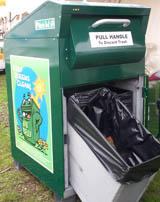
Have you seen this? It is a solar powered trash compactor. There's one across the street from the building where I work. I couldn't figure out what it was for a while. It had a 'Keep Queens Clean' poster on the side, which made it look like it had something to do with garbage or recycling, but the shape is more like a mailbox. And the solar cells on the top were puzzling. So I did a little research, and found out that this is the latest thing in garbage disposal.
For only $4,500, you too can purchase a solar powered trash compactor. The advantage is supposedly that the trash is compacted by a factor of 8. I have to warn you, though, that the lid and chute into which you feed the garbage gets pretty disgusting.

But while we are on the topic of garbage, at least it's better than the garbage cans on my side of the street, which have these attractive rounded tops, with cute little half-circles cut into them to deposit the garbage. The openings are cleverly just a tiny bit smaller than salad-bar take-out containers, thus forcing people to actually carry their garbage back to their desks rather than fill up the cute trash cans.

And that brings us to the trash can in the ladies room at church. I don't like the fact that you have to lift the lid with your hand. Doesn't that sort of defeat the fact that you just washed your hands? And if you take an extra paper towel to lift the lid with, it defeats the purpose of having the garbage can anyway, since you walk out still holding the extra paper towel.

Then there's the recycling notice we periodically get at work. The company wants to recycle all the computer printout. It's a goal I agree with, but the method never quite works. Basically, the problem is that in order to recycle the paper, it has to be separated from other kinds of garbage (such as the salad-bar containers that we carried back to our desks at lunch-time). For a while they actually gave us each two wastebaskets at our desks, that were color coded to separate recycling from garbage. I think that was too much work for the maids -- it's not as trivial as it sounds, because they have about 100 wastebaskets to empty just on one floor. So now they want people to throw only recycling paper into their desk wastebaskets, and to hand carry all other kinds of garbage to the receptacle in the central hallway.

There are a couple of problems with this. One is that I don't think 100 people will bother walking across the entire wing every time they want to throw out a soda can. But even if they solved that part, there is a more fundamental flaw. They haven't quite figured out that the maids empty all the garbage cans into the same big disposal bins for removal. It sort of reminds me of the story of the teen whose mother explained how to sort laundry before sending him to college. He carefully separated the lights and the darks, and then innocently dumped both piles into the same load.

Saturday, September 24, 2005

I forgot, it's not about me


As most of you know, I lead a service in the nursing home twice a month. Recently, I was feeling discouraged because my one regular volunteer had to drop out for a while.

I asked myself why I was bothering to keep showing up after all these years.

I asked myself whether a more gifted person would be able to draw more volunteers.

I asked myself whether the number of people who sleep through the service is proof of how boring I am.

I asked myself why the staff didn't know any better than to stand behind me carrying on a distracting conversation, while I was trying to lead the service.

I asked myself why I bother trying to pray for each one individually at the end, when half of them are suddenly desperate to get out of the room instead. Of course, the ones that aren't trying to leave are desperate for attention. Two of the ladies were gravely insulted a couple of weeks ago, because they felt they had been intentionally skipped by my partner who was covering their half of the room. I had actually heard him greet them by name, so I'm confident they weren't skipped, and I think the problem was that 5 minutes later they simply didn't remember being prayed for. But they were truly offended, and I had had to beg their forgiveness. I asked myself what the point was.

I asked myself whether the heckler should be teaching me something. While I was leading a prayer for the victims of Katrina, she kept shouting "Get a move on!"

And then I looked out at the room filled with old people in wheelchairs, and noted that it was more crowded than usual. There were 30 people, not counting the staff. I suddenly realized that there are full-fledged churches that average fewer attendees than that (even though theirs are probably all conscious, and some of mine aren't). And God reminded me that it's not just a room filled with wheelchairs, it's a congregation.

And then, one of the aides ran up to me and gave me an exuberant hug. Last time she asked me to pray because her daughter had moved to Florida, and didn't have a job. She could hardly wait to tell me the news that her daughter had found a job.

And then, after the service, one of the ladies called me over, handed me an envelope, containing a note with some inspirational sayings, pulled me close and said sincerely "you are a good preacher". I always think of myself as a teacher, not as a preacher, so it was a particular gift that day for her to affirm that.

And I suddenly realized once again, that it's not about me. I was worried about my lack of help, and my lack of gifting, and even my lack of motivation, but in the meanwhile there was a congregation waiting to be fed, and comforted, and prayed for.

Wednesday, September 14, 2005

How do you reach out, without watering down the gospel?


I often get stuck on this question. How do you reach out, and find common ground, and show respect to the other person's beliefs, without watering down the gospel?

I've heard about the abuses that missionaries have committed in the past, where they were as vigorous about standing for Western culture as they were about the gospel. I remember in particular a story that is not especially important, but seemed really symbolic of the problem. A missionary visited a tribe, brought her own cultural mores, and left (I don't recall the circumstances). But the sad part is what happened when a new missionary came years later. The local people were shocked and suspicious of the new missionary, because she was evidently not a holy person. What were the grounds for this accusation? She wore the wrong kind of shirt. The previous missionary had been fond of a particular style, and had somehow communicated that this was the symbol of holiness.
So I can see the arrogance and stupidity in that, but I find it hard to understand what to do in real life.

What about visiting religious services in other faiths? How much can you participate? I know that I'm not likely to visit a seance, for example, (unless God specifically leads me to do so), but what about things that are not so overtly demonic? What about festivals for the earth goddess? What about non-Christian meditation? What about new age practitioners? Where do you draw the line between respecting them as a person and condoning what they are doing?

Usually I end up just standing with a sort of frozen smile while they tell me about whatever 'wonderful' thing they are involved with, because I'm trying to build a starting point of respect rather than argument. But then I wonder whether I'm just being a chicken. Maybe it's just an excuse on my part, and I'm actually afraid to share the Gospel. I have to admit that I'm truly not sure which it is.

When I read Paul's letters, it seems that he usually just jumped in with both feet (not worrying about his listeners' self-esteem as much as we do!) But then there was that time in Athens that he drew a parallel with their own beliefs.

Years ago, I read a book called Bruchko, by a missionary to the Motilone Indians. I read it about 25 years ago, so I probably have some of the details mixed up. He entered their culture, and spoke in analogies they could understand. For example, when he was trying to teach them to disinfect their huts, he told them that bleach would kill the evil spirits, and even showed them germs under a microscope, called them spirits, and said he could kill them. Clearly, God anointed his work, and there was terrific fruit. But I'm not sure what the best lesson is to learn from it.

Maybe it all boils down to learning to listen God, and be led by God, rather than copying someone else's technique.

Thursday, September 08, 2005

Figs and Chayote


For me, one of the big pleasures of travel is trying different foods.

I just went to the market, where I purchased some fresh figs. As soon as I saw them I was transported to a teak sailing vessel in the Agean Sea, off the coast of Turkey. I remembered the sun, and the motion of the waves, and the bees buzzing about, and the sweet, tender juicy fig. If you have only eaten dried figs, the fresh variety is totally different. In fact, it is sort of like the difference between a raisin and a grape. You dry the latter to get the former, but you would never confuse the two. Unfortunately, the figs I bought at the market were but a pale shadow of their Turkish cousins. Seated at the table on the deck of our gulet, we bit into the fresh figs, and agreed that we had never tasted anything quite like it.

At the same market, I noticed chayote. This is a pale green squash that I encountered in Costa Rica. It has a mild flavor and a smooth texture. It's rather innocuous -- not really the kind of thing I expect anyone to love or hate. But just seeing it reminded me of dinner in the middle of the rain forest. The nearest town was only two blocks long, and was a hard 50 minute drive from the hotel. We had purchased the ingredients for dinner based on a shopping list that our guide had recited to us, while we frantically made phoenetic notes. We eagerly rushed into the shop and hopefully recited the unfamiliar words -- chayote among them. The shopkeepers were friendly and helpful, but couldn't understand why we didn't smile and say 'Si' when they gestured to the desired item. How to explain that we didn't even know what we were asking for, so we didn't know whether we had found it!

Back at the hotel, we were invited to help make dinner if we liked. I was eager to see what would be done with these mysterious foodstuffs. Each was peeled, chopped, and thrown into a huge pot. We eventually ended up with a tasty soup. As I recall, the vegetables were scooped out and served separately, but then we each received a bowl of broth into which we dumped the vegetables again. I'm not sure we did it 'right', but we enjoyed it. To this day, the sight of a chayote brings back the aroma of the soup, and the good humored amusement of the cooks who saw that we didn't even know how to prepare simple vegetables.

TV worth watching--Bonhoeffer


Steve's blog inspired me to comment on a program I saw on PBS, about Bonhoeffer. Dietrich Bonhoeffer resisted Nazi Germany (even to the extent of being part of a plot to kill Hitler) and was executed by hanging, on April 9th, 1945. The movie contrasted his endeavors with the behavior of the church at large.

I never realized how much the churches actually went along with Naziism -- I guess I was assuming that it was sins of omission (bad enough), rather than sins of commission.

Hearing that the churches actually prohibited semitic pastors, and finally semitic members, makes me wonder what they would have done had Jesus tried to walk in...

It makes me understand that the Jewish fear of Christians is not just paranoia, but is rather something that needs to be addressed by honesty and repentence on the part of the church at large.

And it also makes me wonder what injustices are going on now, about which history will ask "where was the church?". Although I guess I should be more concerned with what God thinks than what history thinks. So let me re-phrase the question: What injustices break God's heart, and therefore should break ours?

Wednesday, September 07, 2005

Cooperation in the midst of tragedy

We've all seen pictures of the devestation in the New Orleans area. It's not just the loss of life, it's the enormity of the relocation effort. And we've all heard the accusations of mismanagement on every level of government. But I want to focus on the flip side -- the fact that tragedy really does bring out the best in (some) people.

I'm sure as the days, weeks and months go by, we'll here anecdotes about personal heroism. And I'm sure that there will be many more stories we never hear about, because the people involved simply felt they were doing the right thing, and didn't call it heroic.

But I'm fascinated by the response of people at a distance -- both individuals and countries. Did you know that countries all over the world have offered help? Some of the poorest countries in the world are opening their hearts to help America. After an initial misguided refusal from the White House, the U.S. is finally accepting at least some of the help.

Bangladesh has pledged one million dollars, and has also offered to send rescue specialists. To put this in context, you have to realize how poor Bangladesh is. Their citizens have an average income of less than a dollar a day.

Sri Lanka has pledged a symbolic amount of $25,000. It may seem trivial until you realize that they are still in the middle of recovery from the tsunami -- which took 41,000 lives, and damaged two thirds of their coastal areas.

Also interesting is the response from countries with whom we have an either controversial or even adversarial relationship. Afghanistan, Iran, Venezuela and Cuba have all offered support.

Many countries have experts who are ready to fly in to help, as soon as they are given the green light. Imagine an international army of specialists, in the areas of medicine, search & rescue, phone lines, water purification, etc.

Lets hope that we are not too proud to accept the help.

Here are a couple of interesting articles on the international cooperation:
Offers of Aid from around the world (CNN)
World offers Aid as a Thank You (CBS)
Wouldn't it be a wonderful thing if this tragedy (and others) caused the people of the world to view each other as human beings in need of comfort and support, rather than as political targets to be used for various agendas.

Sunday, September 04, 2005

different ways to say Goodbye

It occurred to me the other day that in many different languages, saying 'goodbye' refers to God. Did you know that in English, 'goodbye' is a contraction of 'God be with you'? Maybe I shouldn't have let the cat out of the bag -- I can just imagine some politically correct secularist claiming that it is innapropriate to say this word in a public place.

The whole question of what 'goodbye' really means came to me the other evening while talking to a Muslim waitress in town. For some reason, I seem to see her almost every Sunday on my way to church, and on Friday evenings on my way home. I'm not sure how it works out that her break happens exactly when I'm passing by, but we generally nod and smile and say 'hi' as I pass.

On Friday evening, I felt led to actually stop and talk to her. I noticed a slight accent and asked where she was from. When she said Cyprus, I asked what language she spoke (since it might be Turkish or Greek). She said Turkish, so I was happy that I had a particular way of reaching out. I said 'hello' to her in Turkish. She was pleased, and said 'merhaba' back. I invited her to church, and she told me she is Muslim. I said she would be welcome to come visit anyway, and she seemed pleased, but her Sunday shift starts at 9:30am so she can't make it.

As we wrapped up our conversation, I said 'goodbye' to her in Turkish. 'Allaha ismarladik'. And she responded with the classis 'Güle güle' , which spoken by the person who is staying, and actually means 'go with a smile'. And then I suddenly remembered that the word for word translation of what I had said actually meant 'I'm leaving you with God, or I put myself in the hands of God'.

That made me think of the other languages that also invoke God's blessing when you say farewell. Think of 'Adieu' (French), or of 'Adios' (Spanish).

I tried looking up some other languages, and found a website that gives common greetings in 800 languages. It turns out that many languages are very specific in how one says goodbye, depending on how many people you are speaking to, or whether you are the one going or staying, or whether it is night or morning, or whether it is formal or informal. My favorite was Kwanyama (a language I'm not familiar with). In Kwanyama you have to keep track of whether you are person #1, 2, 3 or 4 in the conversation.

Just remember that when you say 'goodbye' you are really blessing someone. In this secular day and age, it's a sneaky way of praying for someone without anyone noticing!

Goodbye!

Monday, August 22, 2005

I didn't know I needed that

Have you noticed the items for sale that you never knew you needed? I have to admit that sometimes I'll see something that I never saw before, and suddenly I develop a need to try it out. (The Mr Clean magic eraser comes to mind -- it really does clean marks on the wall). But then there are the items that I don't need, I don't want, and I don't understand why anyone is buying them.

  • Premade, frozen peanut-butter and jelly sandwiches. I do realize that one of my very best friends thinks these are wonderful, but I still don't get it. Maybe its because I like the version I make for myself: toasted multi-grain bread, macadamia and cashew nut butter, and raspberry jam. Yum!
  • Premade jello. When you make it at home, the entire recipe consists of boiling water and stirring. So buying it already made baffles me.
  • frozen yogurt and ice cream for DOGS! This is the item that gave me the idea for this blog. I don't know about you, but my freezer does not have any extra room for doggie ice cream. I've got regular ice cream, lime ice pops, and soy ice cream, as well as some leftover Italian ices from my last kinship, and that uses up my allocation of ice cream real estate.
  • Candle warmers. These take a little explanation. The purpose is to warm up the candle so the aroma comes out, and you don't need to burn the candle. Considering the fact that I'm always seeking for pretty unscented candles to burn, the idea of doing the reverse puzzles me.

I bet you can think of some more contenders for this category -- I didn't know I needed that!...

Wednesday, August 17, 2005

Do you ever wonder?

A friend of mine recently went to London on a business trip, and enjoyed walking through all the wonderful historic churches. He encountered one I had never heard of: St Andrew-by-the-wardrobe. (The hyphens are apparently part of the name). Clearly, Andrew must have been a popular saint's name, in order to require such a distinctive qualification. So I wonder, WHY was he called that? How long was he by the wardrobe? Maybe he wanted to be a pole sitter but had a fear of heights, and tried to start a new discipline, but it never caught on. If you know the answer to this one, please tell me.

Well, after getting Andrew-by-the-wardrobe stuck in my brain, I was suddenly noticing saint's names all over the place. For some reason that I cannot explain, I was browsing through the yellow pages one day, and started reading all the church names. I was delighted to find that right here on Long Island we had our own distinctive name: Our lady of Peach. It reminded me of the legend that puts Mary in Ephesus in her later years, and about the fact that Turkey has wonderful aromatic peaches, and I was trying to recall whether any of the icons in Ephesus showed Mary holding a peach. Of course, a few hours later I realized that it was a typo, but I sure enjoyed it while it lasted.

Moving from the sacred to the secular, there's another thing I wonder about TV commercials. Who chooses the music that goes with them? There was one a little while ago that played Carmina Burana. I don't remember what the Ad was for, but I found the music an odd choice. If you are not familiar with it, here is an English translation of one of the verses in the first movement:
Fate is against me
in health
and virtue,
driven on
and weighted down,
always enslaved.
So at this hour
without delay
pluck the vibrating strings;
since Fate
strikes down the strong man,
everybody weep with me!

Why would anyone want to buy this product?

And a more recent commercial that bugs me is the Toyota ad that uses an arrangement of What Shall we do with the Drunken Sailor. Who thinks these things up? Should we really be singing about drunken sailors when buying cars?

Tuesday, August 09, 2005

More about 'J'

I got a call this evening from 'J'. She had been thinking about my invitation to church, and was calling to ask some questions. She was pretty motivated, because she didn't have my phone number, and also didn't remember my last name. So she had to do some detective work.

She was also worried about whether we have communion and whether she would be allowed to skip it, because she is Catholic, but isn't allowed to receive communion in the Catholic church (because she is in a non-Catholic marriage). She is clearly struggling with the issue that her own church wants her to get her marriage annulled, which she is not planning to do, yet she still feels she must abide by it's regulations in regards to communion.

Pray for 'J'. Pray that the Lord draws her heart. And while we're at it, lets pray for her husband, too.

Thursday, August 04, 2005

A third conversation with 'J'.

I missed an opportunity today to pray for someone. I can think of lots of excuses, but the fact remains that I missed an opportunity.

'J' is a neighbor of mine. Other than saying 'Hi' when we pass each other in the parking lot, I've only had two actual conversations with her before today.

This afternoon, my doorbell rang. That's pretty unusual for me. I was surprised to find that it was 'J'. I didn't understand what she wanted. She invited herself in, and I was sort of taken aback, but said ok. She asked whether I was on vacation (since I'm not usually home in the afternoon), and I explained that I was recuperating from major surgery.

She immediately jumped in with her story -- a long list of vague physical complaints that have all subsided except for indigestion. She speaks in a verbalized stream of consciousness, like the world's longest run-on sentence. She asks questions but doesn't pause for a response.

And I didn't feel well and I went to the doctor and he said I was fine and he did tests and he said I was fine did that ever happen to you? and then I felt better except I still have a burning pain in my stomach, and he said it's stress, can stress cause that? and he said I need to see a therapist, do you think I should? and he said I can take tums, did you ever take tums, and I went to a health food store and asked them I guess they should know what they are talking about and they gave me some stuff and what if something is really wrong can stress cause this and I don't know what to do!

At that point she started crying, so I got up and gave her a hug, and had her sit down, and tried to find out what she wanted. I suggested that she try following her doctor's instructions. But I was still to confused at what she was doing there to realize that what I should have done was offer to pray for her.

As she was walking out the door, she suddenly asked me what church I went to, and I invited her to visit, and explained that after each service there is an opportunity to receive prayer. But I blew my own opportunity to pray with her right then. Oh well. I was taken aback by some of the odd things she had said (which I haven't even included here), and I just wasn't thinking.

So you guys can be praying that I'll get another chance to minister to her. And also pray that I have the grace to handle it well, because she kind of drives me crazy.

Thursday, July 28, 2005

Daytime TV--the commercials

Now that I'm becoming a connoisseur of daytime TV, I'm realizing that it's not just the shows that are different, it's also the commercials.

Sitting at home, I have inadvertently entered a different culture. I'm learning about motorized scooters, for people who just can't get around anymore. Apparently the people with these scooters also get free plastic surgery so their mouths are fixed permanently in a smile position.

Then there are various health and pharmacy plans. The best ones let you see whatever doctor you like with no referrals and no co-pay, and also get prescriptions included. It sounded like a good deal to me, but I'm not on Medicare so I don't think I qualify. But I suspect there was some fine print.

Then there are the bed and mattress commercials. For some reason, the most prevalent mattress companies all begin with the letter 'S'. Sleepy's, Serta, Simmons. And the one showing the most ads now is Sleep Number. We are treated to innumerable little vignettes of happy couples, whose entire lives have been changed due to their ability to set the two sides of the mattress to different firmness levels. Each ad is structured like a classic short story, with a situation, a conflict and a resolution. Here the people start out frowning, and end up smiling.

Then there are the legal ads, such as the one trolling for clients with defective pacemakers, or people who have been injured in nursing homes. No one is smiling in these ads.

The only positive thing I can say about the daytime commercials, is that at least you can tell what the ad is about. But the topics are pretty darn limited. It's sort of like going to a library and suddenly realizing that they only have books in one genre, like sci-fi or short stories.

My big disappointment is that my favorite commercial in this genre is no longer shown. You would think that if they do re-runs on all the programs they could do re-runs on the commercials too. The tag line has entered popular culture as a quotable quote: "help! I've fallen and I can't get up".

I'm thinking of starting a petition for better commercials on daytime TV.

Daytime TV

I've got to start with an apology to anyone who really loves gameshows -- you'll see why at the end of this blog.

While I've been recuperating at home, I've been watching more TV than usual. It's a different world (no pun intended). It's not just more TV, it's different.

For a while I thought I was doing well at holding back the influx of the inane, not to mention the insane. I limited myself to one talkshow per day, and chose the one that even seemed to have some edifying moments. I prided myself on avoiding the daytime dramas, and didn't pick up any reality shows.

But then I had a bit of a relapse, and found myself channel surfing. I innocently found a rerun of Jeopardy, and didn't realize that I had been sucked into the Game Show Network. Hour after hour passed, and the quality dropped show by show. By the second day, I clicked to GSN immediately. Some of it was like being in a time warp (just look at the haircuts on Family Feud). But some of it was culturally up to date -- did you know that there is a show where you indicate your desire to play the next round by chanting: "I need greed"? For some reason everyone claps at this point.

Anyway, I reached my nadir with an episode of the Newlywed game, followed by the Dating Game. I can't even explain why I was watching. It wasn't even particularly interesting or funny, and certainly wasn't edifying.

That night I was praying, and confessed to God that I had wasted time on this junk, and asked for help since I didn't even have the motivation to say I was going to try to do better.

This is where the apology comes in, because the following incident probably impacts lots of people besides me.

The next day, I found that Cablevision had pulled the channel from their lineup -- you need a different level of service to get it.

The moral of that story is, to be careful of what you pray for! Of course, another way of looking at it is that God was protecting me from myself.

Saturday, July 23, 2005

A Walk in the Park

In case you were wondering why I haven't blogged lately, I have been recovering from surgery, and nothing really seemed interesting enough to bother blogging about.

While I recover, my daily schedule is very different from my normal frantic rush. Every day now, I get up and go for a walk in the park. I've noticed some curious patterns.

  • Almost everyone in the park is retirement age. I wonder what it must be like to have the free time to do this regularly.
  • The most popular activity is tennis -- the courts open at 8:30am, and people are lined up waiting. The men generally wear tennis whites, while some of the women go a little bit crazy and dare to wear lavender shorts.
  • Women like to walk in pairs, chatting sociably. One woman proudly sports a metallic gold fanny pack
  • Men like to jog or bike by themselves, purposefully. On the average they work out harder than the women. Their faces are sometimes alarmingly red, or even more alarmingly grey. I find myself reviewing the steps of CPR in my mind, and wondering where the nearest defibrillator is.
  • One couple walks together. Every once in a while, without any apparent signal, they break into a jog for a short distance before dropping back to a walk. They always look very serious. They don't talk, although they might politely nod the head as I pass.
  • Most of the single walkers are listening to I-pods.
  • I haven't seen anyone pushing a stroller. Don't people do that anymore?
  • I haven't seen anyone riding a horse (even though the nicest paths are equestrian-only).

It's as if I am a temporary member of a different society. But my Visa will be expiring soon and I'll be returning to my normal 'country', where I get up and get on the train instead of going to the park.

Sunday, June 26, 2005

The scent of summer

Have you ever noticed that various seasons smell different?

Winter smells clean, and sometimes prickly.
Spring starts with the smell of thawing earth, and then eases into the aroma of flowering bushes -- Lilac is my favorite.
Summer smells like cut grass, and if you're lucky, like Roses.
Fall used to smell like burning leaves (when it was still legal), but now tends to have a musty scent of rotting leaves.

There is a wonderful tree I pass on my way to work. It is fading now, but it has aromatic flowers that look like tiny little orchids. They strew the ground as if a profligate flower girl has escaped from a wedding. I have no idea what it is. I also like the fact that it flowers after all of the spring trees, but before the summer flowers really get going. It grows intertwined with a Maple, so I never even notice it until it is fully in bloom, and the aroma stops me and causes me to look around.

p.s. to anyone who drives down North village avenue, the tree is in between the tudor and the medical building. Do you have any idea what it is?

Wednesday, June 22, 2005

VLI is over

I can't believe that VLI is actually over. I'm left with a big muddle of thoughts and feelings.

  • It's been two years (7 quarters, actually).
  • It has been wonderful, but also tiring.
  • I haven't cleaned my apartment in 2 years. (As a friend used to say, "when you're looking for an excuse any one will do".)
  • I've learned a lot. Although I'm a little afraid that I've turned into a little Steve Robbins clone. Not that I know anywhere near as much as he does, but I've been fully indoctrinated into the Steve Robbins zeitgeist.
  • I'm sold on the concept and plan of how VLI balances the requirements -- some is taught at a distance (which gives the opportunity to hear from world renowned experts), and some is taught locally (which gives an opportunity for accountability). Some is academic (which provides a foundation) and some is practical (which also provides a foundation).
  • It's clear that my personality is not suited to be a church planter. It sounds like a nightmare to me. I can't believe anyone wants to do that (although I'm glad they do, and I wish them well!)
  • I really really recommend VLI...but you do have to count the cost.
  • My younger classmates (both at my own church and elsewhere) really do memorize things much quicker and easier than I do. And they are much better as figuring out what they really need to spend time on, and what they can kind of gloss over. But it kind of reminds me of Fried Green Tomatoes. Remember the scene where the pretty teens swoop in and 'steal' the parking spot, and then obnoxiously explain "Face it lady, we're younger and faster!" Middle aged Evelyn then repeatedly crashes into their car (intentionally), and calmly replies: "Face it, I'm older and I have more insurance." Well, I'm older (and slower), and have better study habits. So it was quite interesting to see how we each compensate with our own strengths.
  • I feel like I've learned about 10% of what was taught. And now I only remember about 5 percent of it. In fact, I almost wish I could take it again.
  • Sometimes it was frustrating taking classes long distance. For example, several classes taught about teams, and how to choose people. In most of the church situations I've been in, however, it ends up being a question of desperately accepting any available warm bodies who volunteer. So how do you get enough volunteers that you even have the option of making a selection?
  • It was a little scary hearing how often the teachers mentioned how cool it would be to be a martyr. Maybe it didn't actually come up that often, but it sure made an impact on me. Cool was not exactly the adjective I was thinking of.
  • One of the best things about VLI was that the teachers combined academic qualifications with passion. It is such a privilege to hear from highly qualified teachers who really want to teach.
  • At the beginning of VLI, I came up with a list of ideas for how to maximize my time to make it through. Most of these ideas actually worked well. The best ones were: getting a headset for my phone at home, so I can do stuff while on the phone, and cutting out random TV watching. I still watch a few favorite shows, but I don't watch aimlessly.
  • I think most people who take VLI will find some pressure point. For me it was doing the projects. I really stressed out over that.
  • It's a little humbling to realize that I'm still totally clueless about the major timeframes and people in the Bible. It's not that they didn't teach it, but my attention span was mainly on the concepts, and the dates and names kind of went in one ear and out the other.
  • Unless you have an extraordinarily good memory, it really helps to come up with mnemonics or rhymes. For instance, the phrase "I Do Eat Peanuts, Not Olives" reminds me to consider whether a Biblical passage is Illustrative, Demonstrative, Exemplary, Prescriptive, Normative, or Obligatory. And then there were the 10 major historical events of the divided kingdom, which I set to the tune of the 12 days of Christmas: For the first major historical event, the kingdom was to-orn in two. For the se-cond major historical event, dynasty of Omri and the kingdom was torn in two... I don't remember all 10 anymore, but at least I remember a few.
  • And somehow, the whole VLI experience has made me really respect and appreciate pastors even more. Thanks guys!

Tuesday, June 14, 2005

25 years later

I just returned from my 25th year college reunion. It's interesting to see what has changed, and what has stayed the same.

  • The smart people are even smarter now.
  • The sweet ones are even sweeter.
  • The selfless ones are still helpful.
  • The library still smells the same. We were all experiencing 'deja smell'.
  • The big sycamore tree still stands proudly on the front lawn. It has been dying for the past 30 years. The replacement tree that was planted years ago is now about 30 feet tall, but the original one won't give up.
  • The showers still switch suddenly from hot to cold (or back again) for no apparent reason.
  • The lake is still beautiful.
  • The stagecoach is still brought out for special events, complete with black horses, and a driver in uniform and white gloves.
  • It's still a wonderful, supportive community.
    But...
  • The spiral staircase seems steeper than it used to be. The hills are steeper too.
  • The beds are narrower. (I actually fell out of bed!)
  • The food is better (although maybe they made a special effort for us).
  • The professors are younger.
  • The Alma Mater is more dated, but also more touching.
  • Only one person was skinnier than she used to be. (And it wasn't me).